Count on less money, later
Part 6 of Before you split the shares: starting a company with other people, and what you can actually count on.
At the end of my fintech, ten employees didn't get their salaries. They had done the work. The money just wasn't there any more.
Part 4 told you where it went. This part is about the quieter way the same thing happens in honest companies, every day: the plan said the money would come, and it came later, smaller, or not at all.
Later
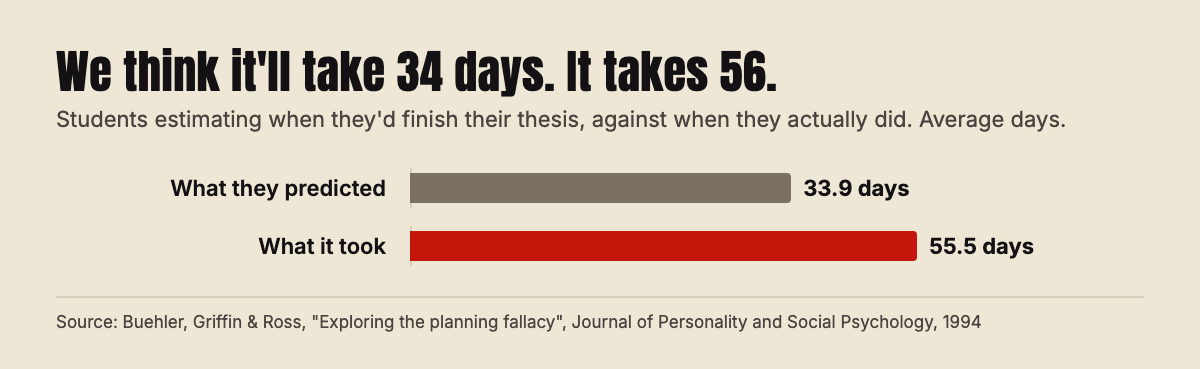
Everyone's plan is optimistic, and it isn't a character flaw. We picture the steps and forget the detours. Psychologists have a name for it, the planning fallacy, and a famous number:
Your first paying customer, your first round, your first salary: assume each one takes longer than your best guess. A lot longer.
Smaller
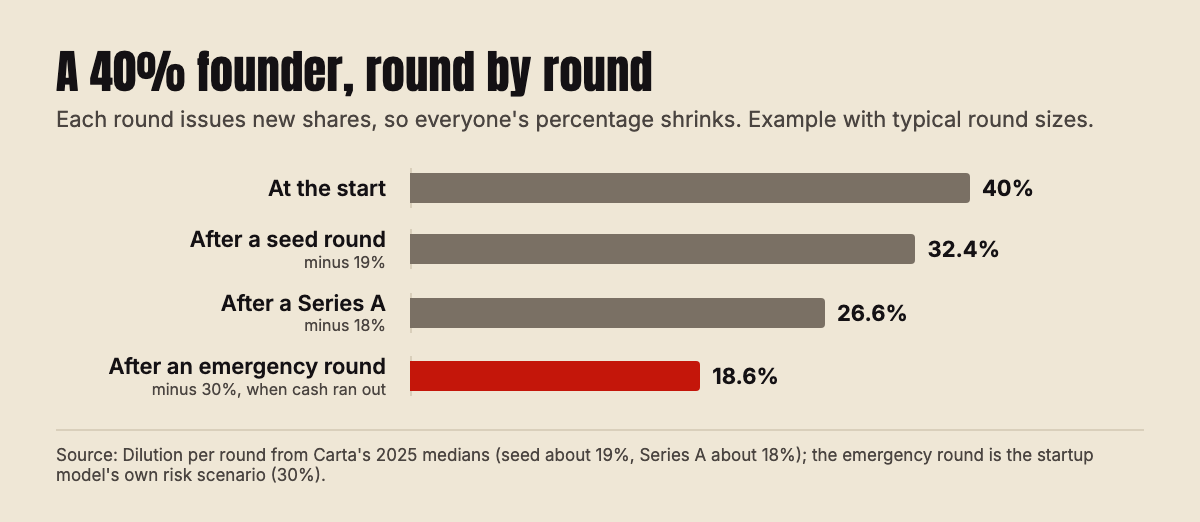
Every investment round issues new shares, and everyone who was there before owns a smaller slice. That's fine when the company grows faster than you shrink. It hurts most when the round is an emergency, because then the investor sets the price.
Cash, not profit
A company can be profitable on paper and still unable to pay salaries next Friday. Customers pay late, the tax bill doesn't. That's why the startup model splits pay into phases, each paying a share of full salary, and its cash-flow tab shows month by month whether the money is actually there to pay them.
What the plan says | What to count on instead (my rule of thumb) |
|---|---|
First revenue in month 6 | Month 12, and half as much |
A round every 18 months | About two years, and a slice of 18 to 20% each time |
Full salaries once we're profitable | Full salaries once the cash covers six months of them |
We'll raise money if we need it | Rounds take months; an emergency one costs far more |
And watch the people as well as the numbers. I've met young founders and seasoned ones, and seen that people go just as crazy from having no money as from having money pour in.
Facts rollup
The planning fallacy: students asked when they'd finish their thesis guessed 33.9 days on average; it took them 55.5. People underestimate their own tasks, not other people's. Buehler, Griffin & Ross, 1994 (PDF)
A round costs about a fifth. In Carta's data, median dilution in Q1 2025 was 18.8% at seed (outside healthcare) and 17.9% at Series A. Carta, State of Private Markets Q1 2025
Rounds are about two years apart. The median time from seed to Series A was around 1.9 to 2.2 years in 2025. Carta
And money is how most of them die: 70% of the venture-backed startups that shut down in CB Insights' 2026 study ran out of capital. CB Insights
The rule of thumb
Run the bad case first: revenue half as big and twice as late as you hope. Find the month the cash runs out. That month is your real plan, and the hopeful one is a bonus.
Outro
The problem: plans assume money arrives on time, rounds are cheap and profit means cash, and they're wrong in that order. The fix is to plan on the pessimistic case, pay in phases, and watch cash month by month.
The other way is bootstrapping: no investors, grow only on what customers pay. You keep your shares and nobody can force a bad round on you. It costs speed, and someone usually keeps a day job for longer than they'd like. I did, for four years. Raising money buys time and costs ownership. Neither is wrong; just pick it on purpose. Last, part 7: the reality check, before you sign anything.
Not legal, tax or financial advice. Ask an accountant where you are before you plan salaries or take money in.
The startup model runs all of this, month by month, in your browser, and sends nothing anywhere. It's free and open source, so you can read every sum it does: github.com/idunworks/startup-model.