The startup reality check
Part 7, the last, of Before you split the shares: starting a company with other people, and what you can actually count on.
Here's the bill for my fintech, itemised.
All the money I put in. Four years of evenings and weekends, next to a full-time job as a developer at one of Sweden's biggest websites. A good job. Ten employees who didn't get paid. A young employee who lent my cofounder money on his last day in the company. I doubt it was ever meant to be paid back.
And sleep. Not in one go. It went down a little every month, for years, until there was almost none. Somewhere along the way my head stopped working. I couldn't think, couldn't hold a problem in my mind, and the job I was good at got harder and harder. In the end I was let go. With a severance, at least, and I'd earned every krona of it.
I didn't see it while it happened. That's the part I want you to take from this whole series.
You won't notice
In a well-known sleep study, people kept to six hours a night for two weeks ended up thinking as badly as people kept awake for up to two nights straight. And they were largely unaware of it. You don't feel your judgement going. The person signing the next paper isn't the one who signed the first.
Check the people, not only the plan
Everything in this series so far was about papers and numbers. This part is about people, because the papers only matter when a person goes wrong.
In my fintech, one person's habits became everyone's problem. I tried to bring in drug tests. That tells you how far it had gone. By the end, his addiction and his megalomania were plain for everyone to see. People go just as crazy from having no money as from money pouring in.
So before you sign, ask each other, and yourself:
Question | Why it matters | Part |
|---|---|---|
Have you told people the idea, and listened to the ones who didn't like it? | Most startups die of a product nobody wanted enough | |
Are everyone's hours logged and priced? | The work is the real investment | |
Does the split match what each will put in and risk from now on? | Shares for work without cash make you the investor | |
If your partner turned against you tomorrow, what could they do without you? | Ownership is not control | |
Is everyone on vesting, with good and bad leavers defined? | One in four teams loses a founder | |
When does the cash run out in the bad case? | Money comes later and smaller | |
Does everyone have a healthy personal economy? | Someone broke at home makes desperate calls at work | |
Will your families back the late nights, or fight them? | You can't build a company against your own home | |
Any habit that money, or the lack of it, would make worse? | It will get worse | |
How are you sleeping? | You won't notice your judgement going |
Facts rollup
Six hours isn't enough, and you can't tell. Healthy adults kept to six hours or less a night for two weeks showed thinking deficits equal to up to two nights without sleep, and were largely unaware of it. Van Dongen et al., Sleep, 2003
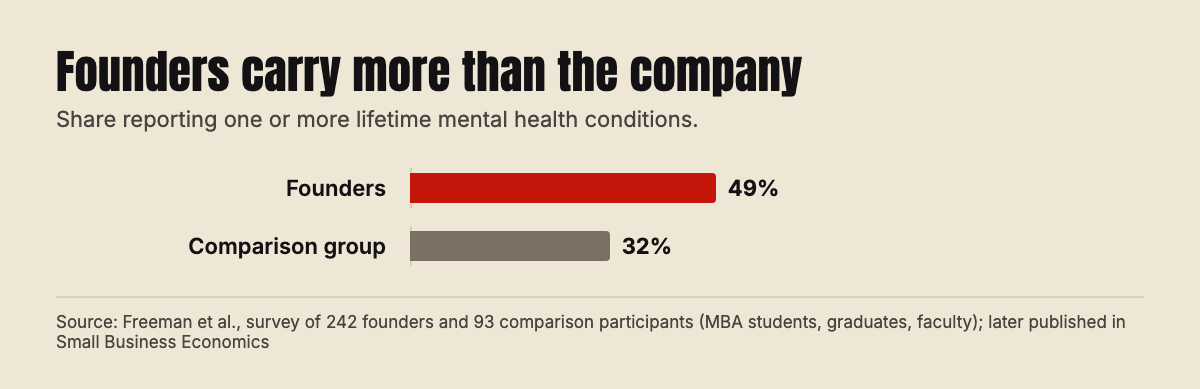
Founders are more exposed. In a survey by Michael Freeman and colleagues, 49% of 242 founders reported one or more lifetime mental health conditions, against 32% of a comparison group. CPA Australia, on the study
The rule of thumb
Answer the table together before you sign. Then put a date in the calendar a year from now and answer it again. If the answers have changed, or if you're sleeping five hours a night, stop and talk before you do anything else.
Outro
Seven parts, one story: an idea is cheap, the work is expensive, the split should follow the work and the risk, ownership isn't control, leavers need rules, money comes later and smaller, and none of it matters if the people go wrong.
The other way is to skip all this and just start. Plenty of companies began on a handshake and turned out fine, and it's faster, cheaper and more fun. It works as long as nothing goes wrong. If you do, at least keep your own copy of everything, your own lawyer's number and your sleep.
Gots to writes thishereshit: Not legal, tax, financial or medical advice. If your sleep or your head isn't right, talk to a doctor before you talk to your cofounder.
The startup model does the sums for parts 2, 3, 5 and 6. It's free, runs in your browser, and the code is open: github.com/idunworks/startup-model.