Tell people your startup idea
Part 1 of Before you split the shares: starting a company with other people, and what you can actually count on. I once lost four years, and a lot more, to a cofounder. This is some of that story and other experiences I want to share.
Somewhere tonight, someone has The Idea. The app nobody has built yet. And they aren't telling a soul, because someone might steal it.
I've sat on the other side of that table, handed an NDA before anyone would tell me anything. More than once. One time, with the paper signed, it turned out there was no idea at all. Another time there was one, and it went ahead without me.
Nobody is waiting to steal it
Most people you tell don't want your idea. They have jobs, kids and their own half-finished project in a drawer. The few who could build it would have to want it more than you do.
And if someone can copy it after one coffee, better to know now and move on. It means the idea was never the hard part.
What talking gets you
The most common reason a startup dies, before the money runs out, is that not enough people wanted the thing. Talking is how you find out for free:
"That already exists." Ouch. Better at coffee than after a year of evenings.
"I'd pay for that." Write the name down. That's your first customer list.
"Who's it for?" The question you hadn't asked yourself.
"Can I join?" Cofounders come from conversations, rarely from job ads. Choose them as carefully as you'd choose who to lend your house keys to. More on that in part 4.
Share the idea, keep the work
Share freely | Keep to yourself |
|---|---|
The problem and who has it | Your code and designs |
Your idea for solving it | Your numbers: prices, costs, margins |
Why you think now is the time | Your customer list and what they told you |
What you're stuck on | Anything told to you in confidence |
An NDA has its place when real material changes hands: code, customer data, a contract. Not for a coffee. Ask for one at the first meeting and an investor will usually say no, and a developer will hear "this person thinks the idea is the valuable part".
Facts rollup
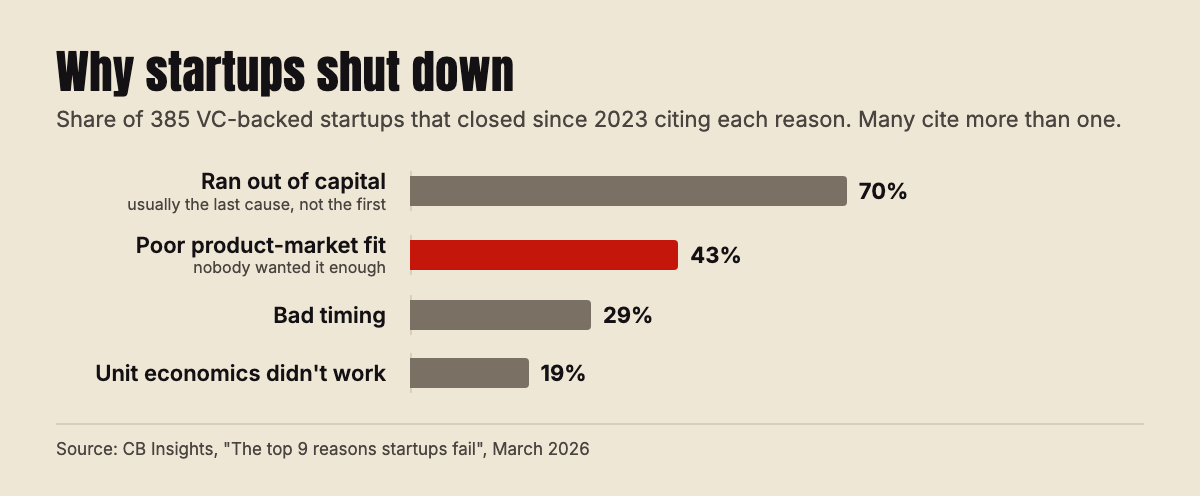
Money is the last cause, not the first. In CB Insights' 2026 study of 385 VC-backed shutdowns, 70% ran out of capital, but the study calls that "almost always the final cause of death, not the root problem". Poor product-market fit, 43%, is the one a conversation can catch early. CB Insights
Two thirds of those product-market-fit failures were early-stage companies that never found a market at all. Same study.
Professional investors rarely sign NDAs before a pitch; many say so openly. They see too many decks to sign for each, and it would tie their hands with the next company in the same space. Cooley GO, DocSend
The study is of venture-backed companies. A small bootstrapped company dies in other ways too, but rarely because someone stole its idea.
The rule of thumb
Tell ten people this month: five who'd use it, three who could build it, and the two friends who always find the hole in your plans. Listen hardest to the ones who don't like it.
Outro
The question was whether to hide a startup idea. Share the idea and protect the work: the idea is rarely what gets copied, and the work is what's hard to copy.
The other way is stealth mode, building quietly until launch. It makes sense when timing really is the advantage, or when you're racing someone with more money. It buys a head start and costs you the feedback, the first customers and the cofounder you might have met. A patent protects an invention, not an idea; it costs real money and only helps if you can afford to defend it.
Next: an idea on its own is worth about nothing. The work costs, and someone pays for it in hours long before there's money. That's part 2.
Not legal, tax or financial advice: it's what I'd tell a friend over coffee. Rules differ between countries, so check how it works where you are.
When you want to put numbers on the idea, the free startup model runs in your browser and sends nothing anywhere.