Splitting the shares before it hurts
Part 3 of Before you split the shares: starting a company with other people, and what you can actually count on.
Someone from the horse trade came to me with a serious offer. She was the real deal: some money behind her, and she knew the business of buying, training and selling horses inside out. At first she didn't even want to tell me what the app was for. (Part 1, anyone?) What she wanted was a demo she could sell to her contacts: three to six months of my work, for 10% of the company.
I wanted something else. We landed on 50%, which sounds good... Then she refused to put in any money up front for my time, so all the risk was on me. Again, she valued her idea a lot but not my time.
Half each, then. Half of what?
Half of nothing, all of the risk
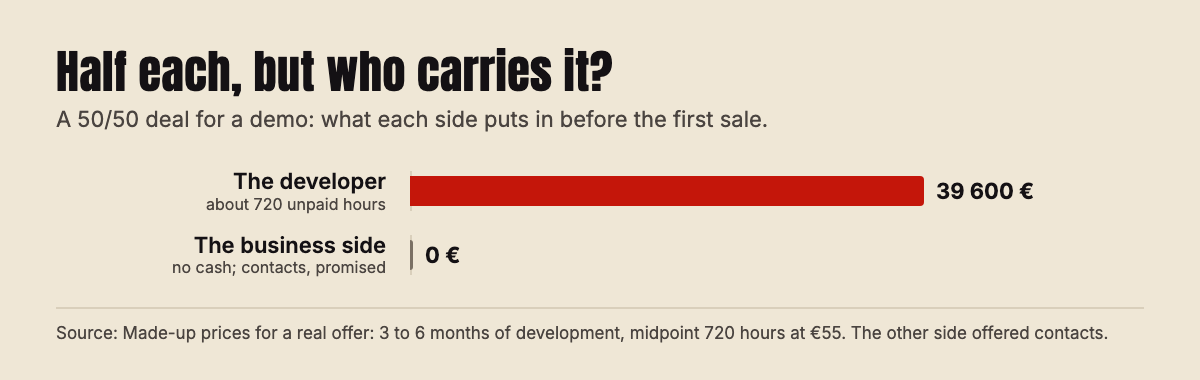
Shares in a company that doesn't exist yet are a promise. If she sold nothing, my half was worth nothing and my months were gone. If she sold a lot, I'd still be the one who had funded it, with time instead of money. Shares for work without cash means you are the investor. Price it like one.
So I asked the questions an investor would. How many customers? What had they promised? How would I be paid back if it never sold? And I proposed vesting, so that both of us would earn our half over time. She couldn't see why I would meddle with her idea like that. She went off to think about the numbers, and never came back.
I walked away. She knew horses, she just had the wrong idea about what an idea is worth.
Who's in the room isn't the question
My fintech had four founders, all former colleagues. I had 38%, my cofounder 42%, and two backend developers 10% each. The two developers joined because of me. That's worth saying out loud when you split: some people bring other people. It was also a split done with good feelings and too little arithmetic, and part 4 is about what that cost.
What should decide it is what each person will put in from here on, not who had the idea or who sat at the table the day it was split:
How you split | Good when | The trap |
|---|---|---|
Equal, on a handshake | Everyone really will put in the same, for years. | Someone always does more, or leaves. Then "fair" stops feeling fair. |
By what's been done so far | The work is mostly behind you. | Rewards the past, and the hard part is usually ahead. |
By what each will put in: time, money, risk | Most teams, most of the time. | Needs an honest talk, and vesting (part 5) in case someone stops. |
Dynamic, adjusted as you go | Contributions really are uncertain. Search for "Slicing Pie". | More bookkeeping. Needs trust in the books. |
Facts rollup
Most teams split fast. In Thomas Hellmann and Noam Wasserman's study of US tech founding teams, 42% agreed their split within a single day, and 32% chose an equal split. Startup Genome, by Hellmann
Equal splits went with weaker fundraising. Teams that split equally were less likely to raise money from outside investors, and had lower valuations in their first round. That's a correlation, not proof that the split caused it. NBER, The First Deal
Founders fall out more than markets do. Wasserman's research has been summarised as 65% of high-potential startups failing because of conflict among the cofounders. CNN Money, 2014
The rule of thumb
Before you split, each person writes down, alone: hours a week for the next two years, money they'll put in, and what they'll do if it fails. Then compare the notes together. And if someone offers you shares for work with no cash on their side, ask what they lose if it doesn't fly.
Outro
The problem: shares get split in a day, on feelings, by who's in the room, and the split then has to survive years of uneven work. The fix: split by what each will put in and risk from now on, and back it with vesting.
The other way is the quick equal split. It's fast, it feels fair and it avoids an awkward talk at the start, which matters when you're friends. It costs you that talk later, at the worst possible time, and the research suggests investors notice. Next, part 4: what happens when the split is fine on paper and someone else holds the power anyway.
Not legal, tax or financial advice. How shares can be split, and taxed, differs between countries, so check with a lawyer and an accountant where you are.
The startup model shows each person's ownership through every phase and investment round. It runs in your browser and sends nothing anywhere.