Who pays for the first thousand hours?
Part 2 of Before you split the shares: starting a company with other people, and what you can actually count on.
For four years I had a full-time job as a developer, and a fintech in the evenings. Nobody paid for the evenings. I didn't count them either, which was the mistake.
The idea is a multiplier, the work is the number
In part 1, I said an idea on its own is worth about nothing. Here's why. A brilliant idea times zero hours is zero. An average idea times two thousand good hours might be a company.
Early on, those hours are paid by the people doing them, in evenings, weekends and sleep. And they aren't spread evenly. Someone writes the code. Someone else writes the pitch. Guess which one takes longer.
What surprised me
When I put a real case into our startup model, one number stood out: how many hours a developer who's there from the start actually piles up, and how little the running costs are next to them. Servers, domains, licences: a rounding error.
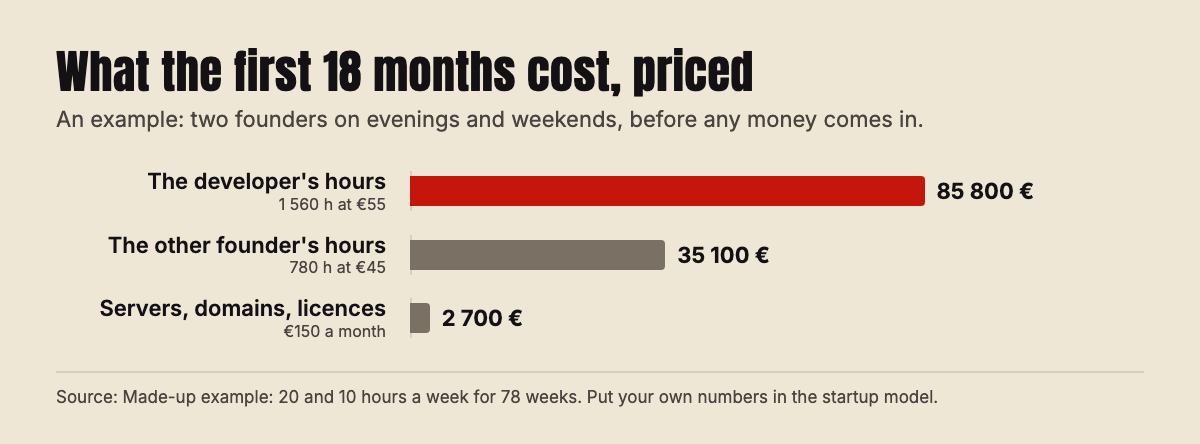
We fuss about the hosting bill. The real money is the time, and it's invisible until someone prices it.
When the hours are on someone else's idea
I've also built things for other people's ideas before there was money, on a promise. It never ended well. Nobody wants to pay for what they ordered if it doesn't fly.
That's not malice, mostly. When the thing fails, there's no money to pay with and no one wants to remember the deal. So the deal has to be on paper before.
Three ways to pay for the hours
How it works | Good for | Watch out for | |
|---|---|---|---|
Shares | The hours buy you a bigger part of the company. | Founders in it for the long run. | Worth nothing if the company is. Needs vesting (part 5). |
Back-pay | Hours are logged and paid back in cash once the company has a surplus. | Evening founders who can't afford to wait forever. | Only paid if there's ever a surplus. Agree the rate and the order of payment up front. |
Paid now | The company buys the hours like any contractor's. | A builder who isn't a founder. | Needs money from day one, which is rare. |
Most teams mix them. That's fine, as long as the mix is written down.
Facts rollup
What the hours are worth once there's money: an analysis of over 450 US seed-stage startups put founders' average salaries at about $132,000 to $135,000 a year. That's the market price of the time you're giving away now. Kruze Consulting, via TechCrunch
Most of those hours are a bet. Of US business establishments started in 2013, about one in five had closed after the first year, and only 34.7% were still operating ten years later. US Bureau of Labor Statistics
Running out of capital is the most common way VC-backed startups die (70% in CB Insights' 2026 study of 385 shutdowns), which is one more reason the first year runs on hours, not money. CB Insights
The rule of thumb
Keep an hours log from the very first evening, for everyone, in one shared sheet. Agree a price per hour, even a low one, and write down whether the hours become shares, back-pay or both. You'll be glad of it when things go well, and even more when they don't.
Outro
The problem: the work that turns an idea into a company is paid in unpaid hours, and those hours are rarely counted, so nobody knows what anyone has put in. The fix is boring: log them, price them, agree how they're paid back.
The other way is not to count at all: share equally, trust each other, sort it out later. It's faster at the start and cheaper on lawyers. It works when everyone puts in about the same and stays to the end. When one person carries the load, or leaves early, "later" is the worst time to start counting. Part 3 is about splitting the shares, and why 50/50 is a choice, not a default.
Not legal, tax or financial advice. How back-pay and shares-for-work are taxed differs a lot between countries, so ask an accountant where you are before you sign.
The startup model has a tab for phases and pay and one for back-pay. It runs in your browser and sends nothing anywhere.