38 percent of nothing
Part 4 of Before you split the shares: starting a company with other people, and what you can actually count on.
The email from the company register arrived on an ordinary day. Something had changed at my own company. I could read about it, but I couldn't log in to do anything about it any more.
I owned 38% of that company. It took me four years to learn what that was worth.
The deal looked fine
From the very start, my cofounder wanted the final say. I let him have it. He worked hard, we had worked together before, and what could go wrong? He had the contracts written, with legal help, and they looked good. I insisted on one thing: a veto on big decisions.
The veto was in our talks and later on paper. His control was hidden in the same papers.
What a determined person can do
As long as everyone acts in good faith, a contract mostly sits in a drawer. When one person stops, you find out what it actually says. Here's what he did, over time:
Borrowed money in the company's name, signing with another person's name.
Held an extra general "meeting" that took away my right to sign for the company. I wasn't invited.
Sold a new class of shares to an outsider, without the rest of us knowing.
By then we had left the board. When you suspect a crime in your own company, you get out of the room where you share responsibility for it.
The money went. Ten employees weren't paid. Courts have since ruled against him more than once. He has never shown up to one.
Ownership is not control
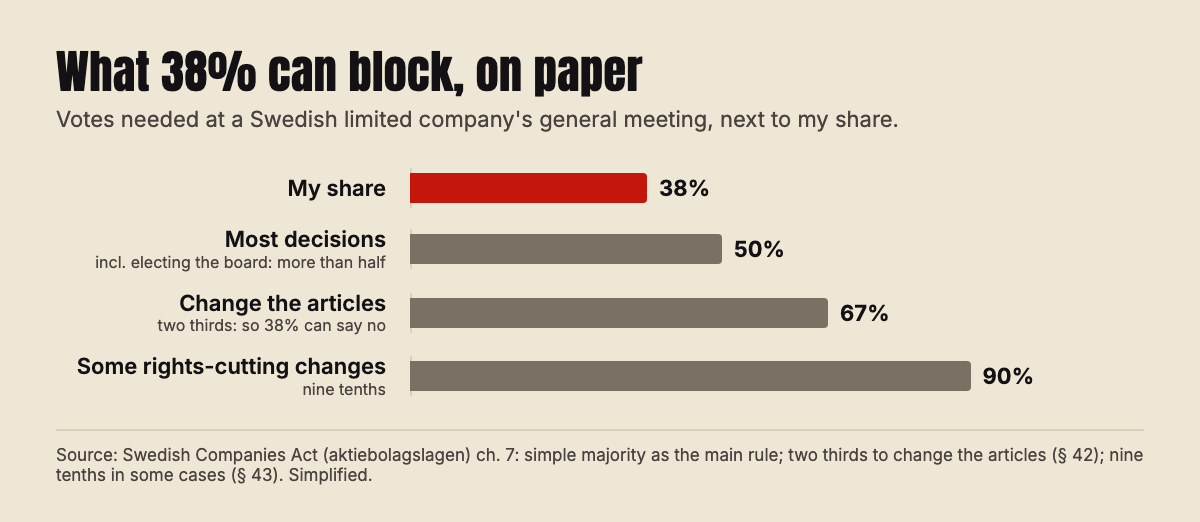
On paper, 38% was a lot. It could block any change to the articles. But a meeting the minority doesn't know about blocks nothing, and a loan signed in someone else's name doesn't go through a vote at all. The law can undo some of it afterwards, in court, at your cost, years later.
What decides your safety is who can act: who can sign, who calls the meetings, who holds the logins and the bank, and whose lawyer wrote the papers. Btw, we all payed for the lawyer costs to move us out. Ironic. Hurts.
Protection | What it does | Would it have stopped him? |
|---|---|---|
A veto, agreed in talk | Nothing | No |
A veto in a shareholders' agreement | Binds the owners who signed; breaking it gives you a claim | Not in time |
A rule in the articles of association | Binds the company, and the register can see it | Harder to get around |
Signing rights for two people together | One person alone can't bind the company | Yes, unless they forge a name |
Your own lawyer reading every paper | Spots control built in for someone else | Yes, at the start |
A board seat and read access to the bank | You see the money move | Sooner |
Alerts from the company register | Tell you after it happened | No |
Facts rollup
Two thirds to change the articles. Under Sweden's Companies Act, most general meeting decisions need a simple majority, but changing the articles of association needs two thirds of the votes cast and of the shares represented, and some changes nine tenths. More than a third can block. Lawline on the voting thresholds
Three months to challenge a decision. A general meeting decision is normally challenged in court within three months, and later if the meeting was never properly called. Lawline on challenging decisions
The register tells the board when the board changes, through the company's digital mailbox. A warning, not a lock. Handelsbanken on company hijacking, although they sat on their hands when I needed to close our accounts due to suspected fraud.
The rule of thumb
Get your own lawyer to read the papers, not the one your cofounder brought. Ask one question: if my partner turned against me tomorrow, what could they do without me? Then change the papers until the answer is "not much".
Outro
The problem: I owned a big share and had almost no control, because the papers gave the power to one person and nothing forced him to use it in good faith. The alarm rang after the door was already open.
The other way is trust, and most of the time it works: most cofounders are decent, and heavy papers can poison a young team. But trust protects you only as long as the other person keeps it. Writing the safeguards down costs an awkward afternoon and a lawyer's fee. Not writing them down cost me four years. Next, part 5: what should happen when a cofounder leaves, and how to get the shares back.
Not legal advice. Company law differs between countries, and even within one it has exceptions. Ask a lawyer where you are, your own one.
The startup model has a risk tab with scenarios like a forced emergency round. It runs in your browser and sends nothing anywhere.