When a cofounder leaves
Part 5 of Before you split the shares: starting a company with other people, and what you can actually count on.
Our first CEO left early. His family needed him, for months, and a startup doesn't wait for anyone. Nobody blamed him. We paid him a small amount for his part, and he went home to his family.
It went well because everyone involved was decent. Nothing on paper made it go well. We had no rule for it, so we made one up, at a bad time for everyone.
Shares that have to be earned
Vesting means your shares are yours over time, not on day one. The common version: four years, with a one-year cliff. Leave before the first year and you keep nothing. At twelve months, a quarter is yours at once. After that, a little more every month.
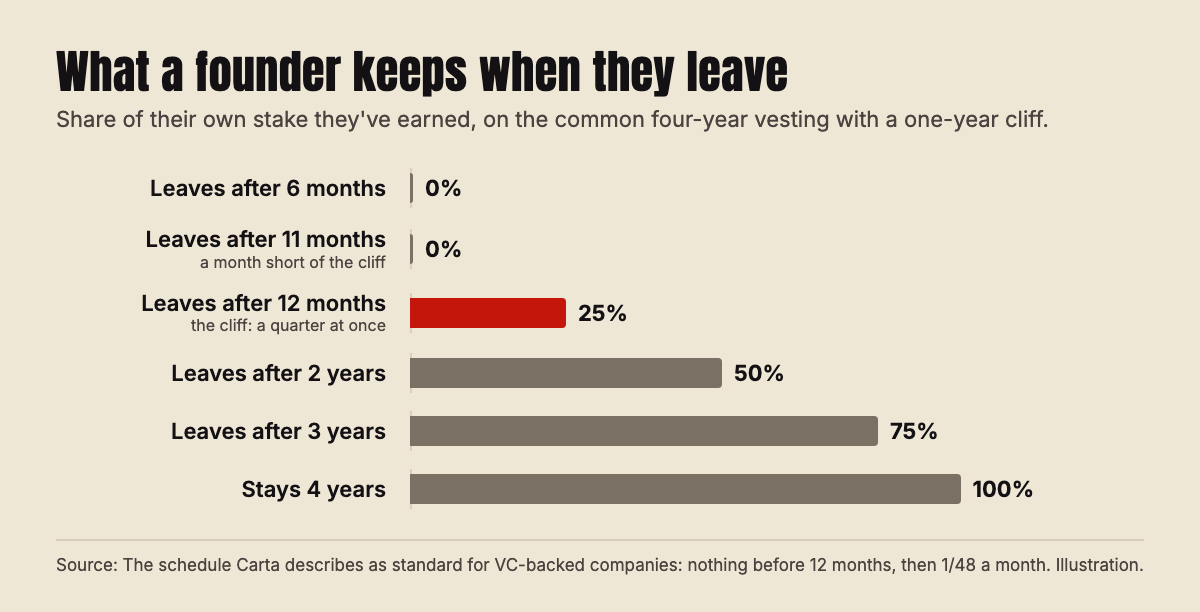
It isn't about distrust. It protects the people who stay from carrying someone who has left. In many countries, Sweden among them, founders get all their shares at the start, and the vesting lives in the shareholders' agreement: the company or the other owners get the right to buy back the unearned shares at an agreed price.
Remember the horse trader in part 3? I proposed exactly this, so that we'd both earn our half. She heard it as me meddling with her idea.
Good leaver, bad leaver
The price of the shares you buy back depends on why someone leaves:
Who it is | The usual deal | |
|---|---|---|
Good leaver | Illness, family, a fair goodbye after the cliff | Keeps what's earned, or is bought out near market value |
Bad leaver | Breaks the agreement, is fired for cause, goes to a competitor | Sells back at a nominal price, sometimes even earned shares |
In between | Simply wants out | Keeps what's earned, the rest at a low price |
Our first CEO was a textbook good leaver. And here's the twist from part 4: the clause assumes the bad one is the one who leaves. In my fintech, the honest people walked out of the board room and the one causing the damage stayed. So a leaver clause needs a partner clause: what counts as breaking the agreement, and what happens to that person's shares, even if they never leave.
Facts rollup
One in four. Carta looked at 13,133 founders of US venture-backed startups and found that about 25% of companies lose a cofounder within their first four years. Carta
Four years and a cliff is the norm. Carta describes a four-year schedule with a one-year cliff as the standard for venture-backed companies: nothing before the cliff, then 1/48 of the grant a month. Carta's vesting guide
The price follows the reason. A typical UK example: good leavers sell at full market value, bad leavers at nominal value. A Swedish law firm's guide makes the same point: the price depends on whether you're a good or bad leaver and how much time has passed. Vestd, DLA Piper Sweden
The rule of thumb
Put everyone on vesting, yourself included, from the first day. Write down who counts as a good leaver and who a bad one, and the price formula for each, before anyone has a reason to leave. It's the only time the conversation is easy.
Outro
The problem: people leave startups all the time, and without a rule, what they take with them is settled at the worst possible moment, by whoever argues hardest. The fix: vesting with a cliff, good and bad leaver terms, and a price agreed up front.
The other way is no vesting: everyone owns their shares outright from day one. It's simpler, and it feels like trust. It works if nobody leaves early, and in one company in four, somebody does. A founder who leaves after six months then owns a slice of every year of work the others put in after. Next, part 6: money, and why you should count on less of it, later.
Not legal, tax or financial advice. How vesting can be written, and how buy-backs are taxed, differs between countries. Ask a lawyer and an accountant where you are.
The startup model shows each person's stake through every phase. It runs in your browser and sends nothing anywhere.